
- Products
- Solutions
-
SolutionsExplore All Solutions
-
- Support
-
SupportExplore All Support
-
- About us
-
About usExplore All About us
-
- Contact



English

PCR consumables provide the reaction vessels required for PCR and real-time PCR experiments. Common formats include individual PCR tubes, PCR strip tubes, 96-well PCR plates and 384-well PCR plates.
The appropriate format depends on sample quantity, testing throughput, reaction setup and instrument configuration. Individual tubes and strip tubes are commonly used for small-batch or flexible testing, while PCR plates are more suitable for standardized and high-throughput workflows. For real-time PCR applications, optical properties, sealing performance and instrument compatibility also need to be considered.
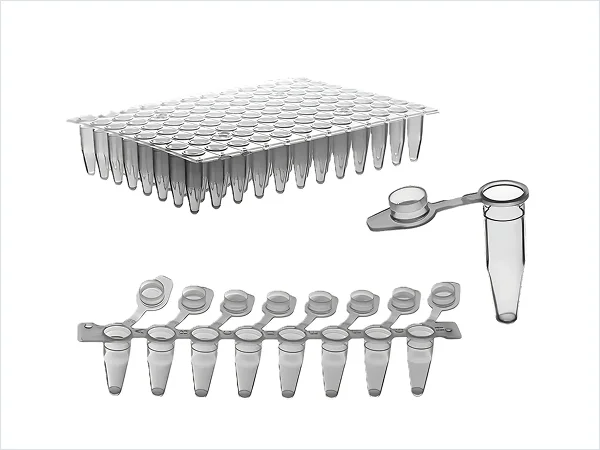
PCR tubes, PCR strip tubes and PCR plates differ in product formats, reaction volumes, materials, sealing methods, optical properties and instrument compatibility. Understanding these technical factors facilitates evaluation of the characteristics of different PCR consumables used in conventional PCR, Real-Time quantitative PCR and high-throughput PCR experiments.
| Key Factors | Technical Points |
|---|---|
| Experiment Type | Select appropriate consumables according to conventional PCR, real-time quantitative PCR, or high-throughput PCR. |
| Reaction Volume | Common specifications are 0.1 mL and 0.2 mL, matching the reaction system and instrument. |
| Material | Preferably polypropylene (PP), which offers good thermal stability. |
| Tube Wall Thickness | Thin-wall design facilitates improved heat transfer efficiency. |
| Sealing Methods | Proper sealing reduces evaporation and sample loss. |
| Color and Optical Properties | Transparent consumables facilitate observation of samples and liquid levels; white or opaque consumables enhance qPCR fluorescence signal reflection; optical caps or optical plate seals are suitable for real-time fluorescence detection. |
| Instrument Compatibility | Confirm compatibility with instrument modules, plate formats, and optical reading requirements. |
| Product Formats | Suitable Applications | Usage Notes |
|---|---|---|
| PCR Single Tubes | Small sample volume, independent reactions | High flexibility, suitable for small-batch experiments |
| PCR 8-Strip Tubes | Conventional PCR, real-time quantitative PCR | Convenient to use, must match 0.1 ml or 0.2 ml modules |
| PCR 12-Strip Tubes | Suitable for certain instrument modules, continuous sample arrangement, or specialized experimental layouts | Confirm instrument well positions, tube height, and module compatibility before purchasing |
| 96-Well PCR Plates | Conventional high-throughput detection | Select non-skirted, semi-skirted, or fully skirted formats based on instrument requirements |
| 384-well PCR Plates | Ultra-high throughput and low-volume reactions | Requires matching 384-well PCR instrument modules |
Note: Different PCR consumables are suitable for varying sample volumes, detection throughput, and instrument modules. Their effectiveness is closely linked to product format, sealing methods, and instrument compatibility.
The effectiveness of PCR Consumables is closely associated with experiment type, sample quantity, working volume, sealing methods, optical requirements, and instrument modules. Conventional PCR experiments generally focus on operational flexibility, heat transfer efficiency, and sealing stability, whereas qPCR and high-throughput experiments additionally emphasize optical performance, well-to-well consistency, and instrument compatibility.
Before use, verify that the tubes, PCR plates, and seals are intact, ensure the reaction solution is positioned at the bottom of the wells, and prevent any liquid residue on the tube walls or sealing surfaces. After sealing PCR plates, also confirm that each well is uniformly sealed to reduce evaporation and edge effects.
By understanding the differences in structure, specifications, and applications among PCR tubes, PCR strip tubes, and PCR plates, you can more accurately choose products that fit experimental workflows and instrument modules, reduce sample loss, poor sealing, and compatibility problems, and improve the stability and repeatability of PCR results.